
Frequently asked questions
At eg. we put the chicken first. We are 100% committed to ethical farming with zero caged, zero colony, and zero barn hens. Our unique shed layout uses a sun shape rather than rows, which gives each flock significantly more roaming space than a standard free-range farm. Happy hens lay perfect eggs, and we think that shows.
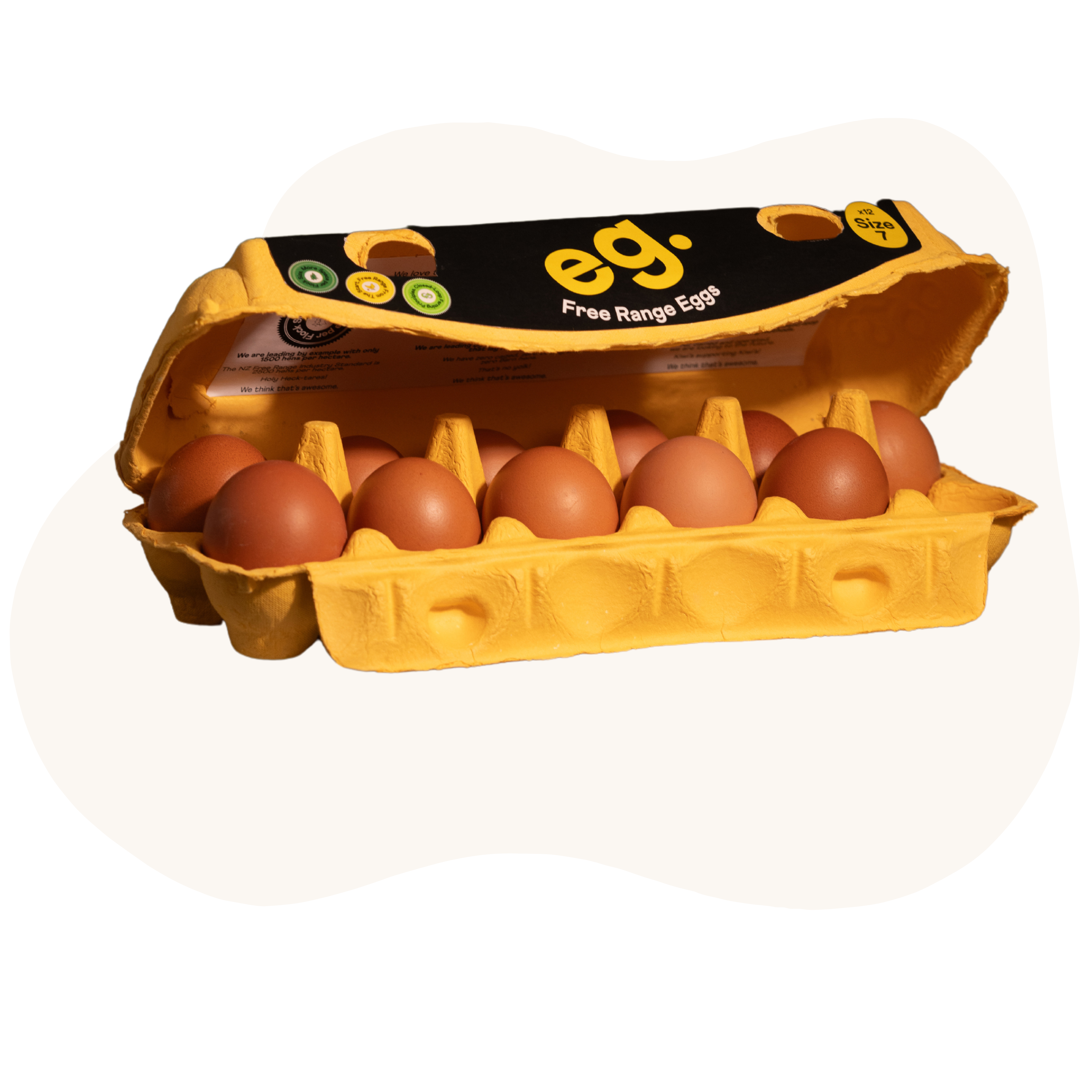
We offer Mixed Grade, Size 7, and Jumbo eggs in cartons of 6, 12, and 20 (Jumbo is 6 and 12 only). We also have a tray range covering Petites, Mixed Grade, Size 7, and Jumbo, which is great value for baking, large families, or commercial use.
Contact Charlotte on 021 617 918 or reach us via the contact form on our website.
Our name is inspired by the abbreviation for "for example." It reflects our purpose - to work hard every day and provide real-life examples of how egg farming can be done better. We want to show the industry, and the world, that when the chicken comes first, everything else follows.
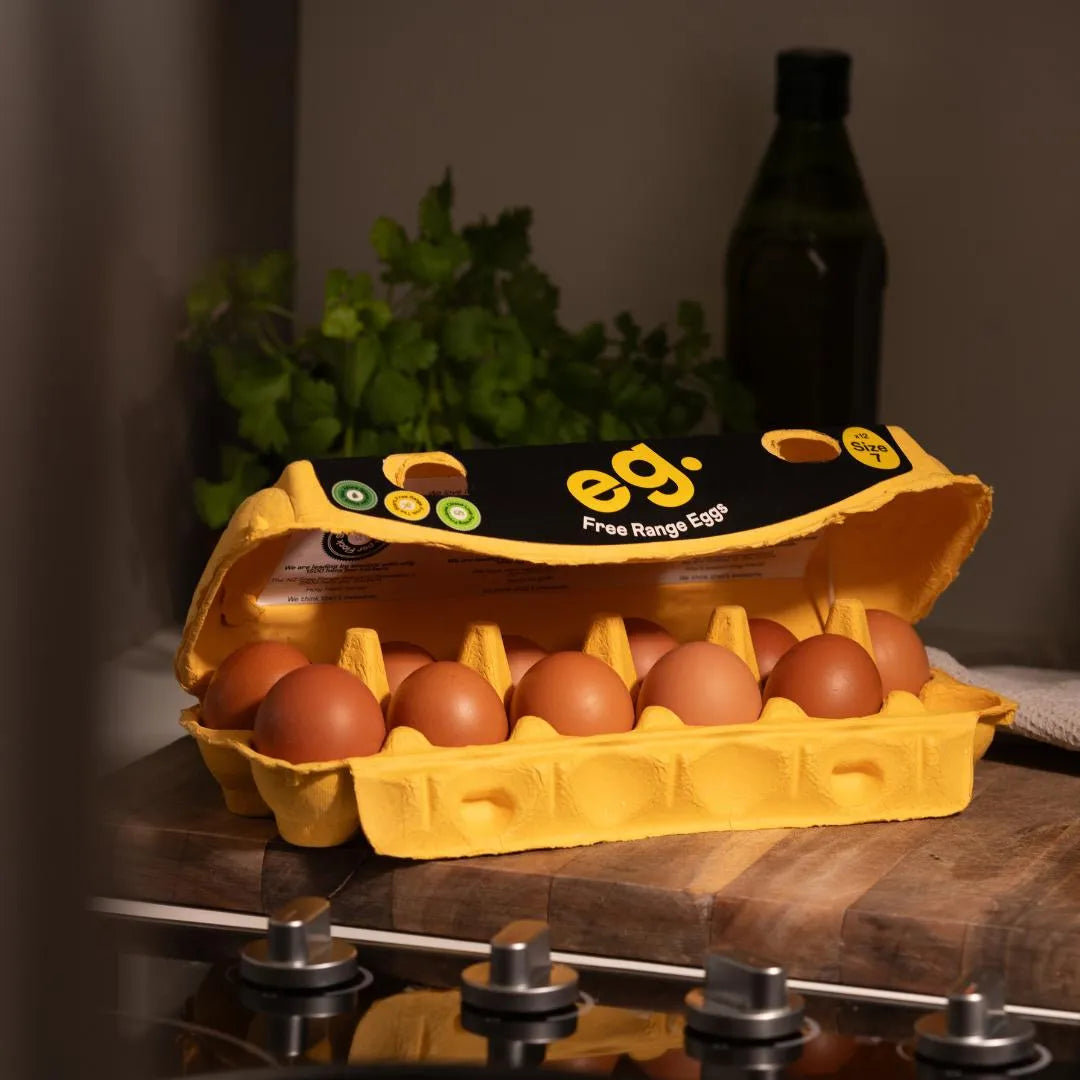
You can find our bright yellow cartons at select New World, PAK'nSAVE, and local
boutique stockists across New Zealand. Use the store locator on our website to
find your nearest stockist.
Yes. Every hen on our farm is free range from day one. We have zero caged, zero colony, and zero barn hens, and our farm layout is designed to give each flock more roaming space than a standard free-range setup
Yes. We work with cafés, restaurants, bakeries, and food service providers across New Zealand. Get in touch via our contact page or phone Charlotte on 021 617 918 to discuss wholesale pricing and delivery.
Yes. Our tray range is available to order directly through our website for home
delivery, subject to delivery zones. Visit our shop page to see what is currently
available.
Our eggs are carefully packed to handle the journey to your door. If you have any
concerns about an order that has arrived damaged, get in touch with us at sales@eg.co.nz and we will sort it out.
Delivery times vary depending on your location. Visit our shop page for current delivery zones and estimated timeframes, or contact us directly if you have a specific question about your area.
Place it in a bowl of cold water. A fresh egg sinks and lies flat on its side. As an egg ages, the air cell inside grows and it will start to tilt upward. If it floats, it is past its best and should be discarded. You can also crack it onto a plate - a fresh egg will have a firm, rounded yolk and a thick white that holds its shape.
Yes, this is completely normal. Hens are sensitive to daylight hours, and as the days get shorter over winter their laying naturally slows down. It does not affect the quality of the eggs, just the volume. If availability looks a little lower during the cooler months, that is why.
A deep, vibrant yolk is the sign of a healthy, happy hen. Because our hens spend their days foraging on open pastures and eating a nutrient-rich diet, they naturally lay eggs with thick whites, strong shells, and rich orange yolks. It is not added colouring or feed additives - it is simply what happens when the chicken comes first.
It can vary slightly. Yolk colour is influenced by what the hens are eating and how much time they spend outdoors foraging. In summer, with more pasture available, yolks tend to be at their most vibrant. In winter they may be a touch lighter, but the quality and nutrition remain the same.
A blood spot is a small red dot occasionally found on the yolk. It is caused by a tiny rupture of a blood vessel during the egg's formation and has nothing to do with fertilisation or the hen's health. The egg is perfectly safe to eat. You can remove the spot with a spoon if you prefer.
You can keep them in the pantry or fridge in their carton, away from strong-smelling foods. Eggshells are porous and can absorb odours, so the carton helps protect them.
Our eggs are laid to order, packed within 48 hours, and sent out for delivery. Eggs are best before 35 days from the lay date, so yours will have most of that shelf life ahead of them when they arrive.
We work with WELLfed as part of our commitment to doing good beyond the farm gate. WELLfed is a free community education programme based in Porirua that nourishes people through hands-on cooking classes, garden learning, and life-skills workshops. We are proud to support their work, which helps build confidence, connection, and wellbeing in the community. Visit our WELLfed page to find out more about the partnership
Closed-loop farming minimises waste by cycling nutrients back into the local ecosystem. In practice, our hens' manure is collected and used to fertilise nearby maize and vegetable crops, which reduces the need for synthetic fertilisers and keeps nutrients in the ground.
We love supporting our local community. Visit our fundraising page on the website
to find out how your group or organisation can get involved, or contact us
directly to have a chat.
Our farm is based on Brandon Hall Road in Bulls, in the Manawatū-Whanganui region. From there we supply fresh free-range eggs to supermarkets, local stockists, and hospitality venues across the North Island.
We are working hard to make our eggs available for as many places as possible. Please visit our shop page for a full list of where we currently deliver to.
Sign up to our newsletter